Skip to content

FizzUp · For teams

Practise the conversations that decide whether work moves forward.

Meetings, client calls, negotiations, presentations. Everyone practises their own situations with the AI coach they choose. The company sees how the group is doing — never what anyone said.

Pilot: 6 weeks · 15–30 people · PLN 120 + VAT per participant per month · Openly AI

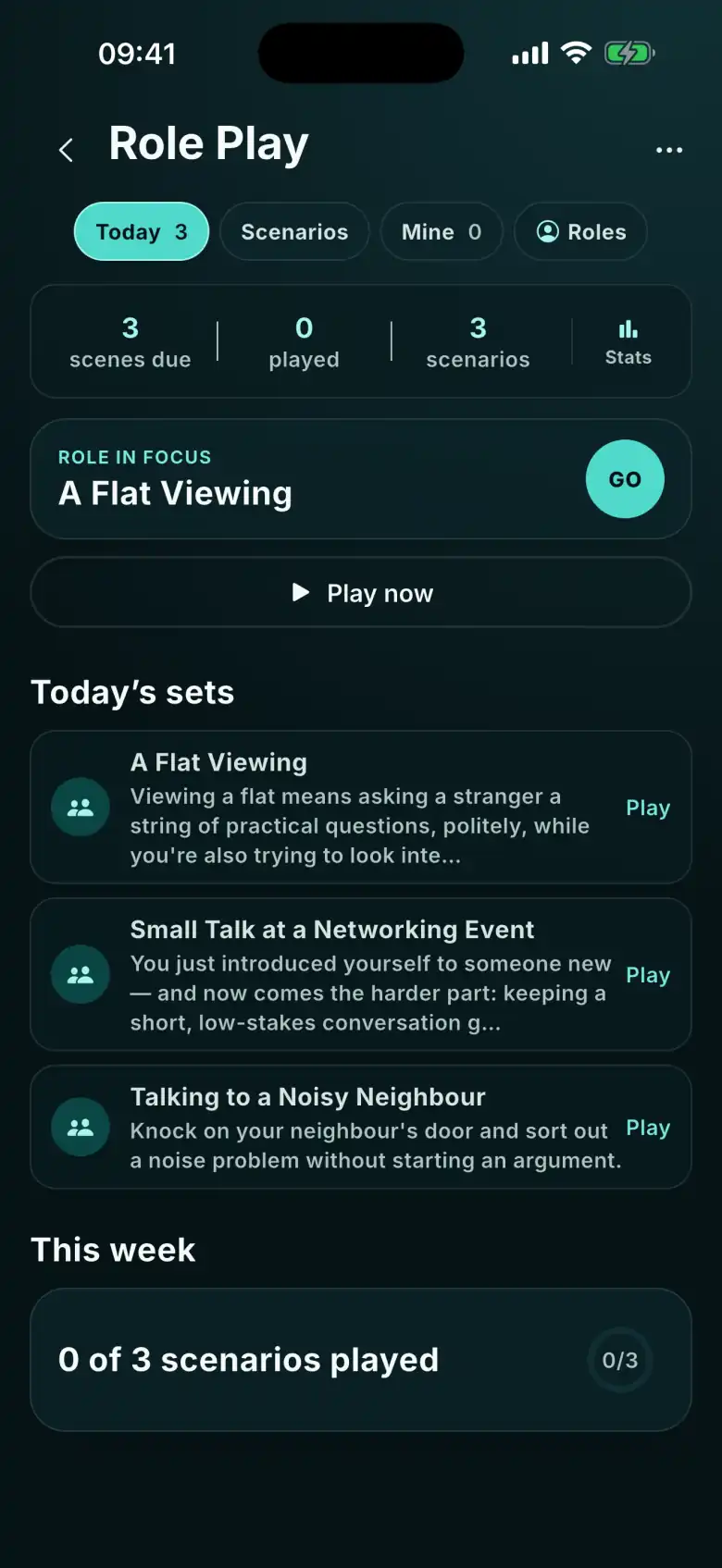
FizzUp Role Play: the role in focus, a Play now button and today’s sets of scenes, including Small Talk at a Networking Event
The employee’s screen: Role Play — scenes from real situations, played out loud or typed.

Three questions

The three questions every decision-maker asks — in order.

We answer them in the order they come up with HR and the board.

  1. What do they practise?

    Their own meetings and conversations — the ones already in the calendar, not topics made up for a course.

    • The topic on screen, with a Change button next to it
    • A two-way conversation — out loud or by typing
    • Transcript, suggestions and saved phrases to hand while they speak
    • A personal plan they can reorder or delete
    • Role Play: scenes to act out — out loud, or typed with no microphone (latest app version)
  2. What do I see?

    How the group is getting on — never the words. It’s a picture of the rollout, not a file on anyone.

    • Invitations sent and accepted
    • Activations — who actually started
    • Active participants over the period
    • Conversation minutes across the group
    • Totals shown only above a group size we agree up front

    There’s no dashboard screenshot here: the programme view hasn’t shipped yet.

  3. What don’t I see?

    This is our argument, so we say it up front — not in a footnote.

    • No one’s mistakes
    • No transcripts and no recordings
    • Nothing from an AI coach’s private memory of a person
    • No ranking of employees against each other

    An AI coach keeps what each person is working on, so the next conversation picks up where the last one left off. It shows them what it knows — on the “What I remember about you” screen — and they can delete it. The company doesn’t see it.

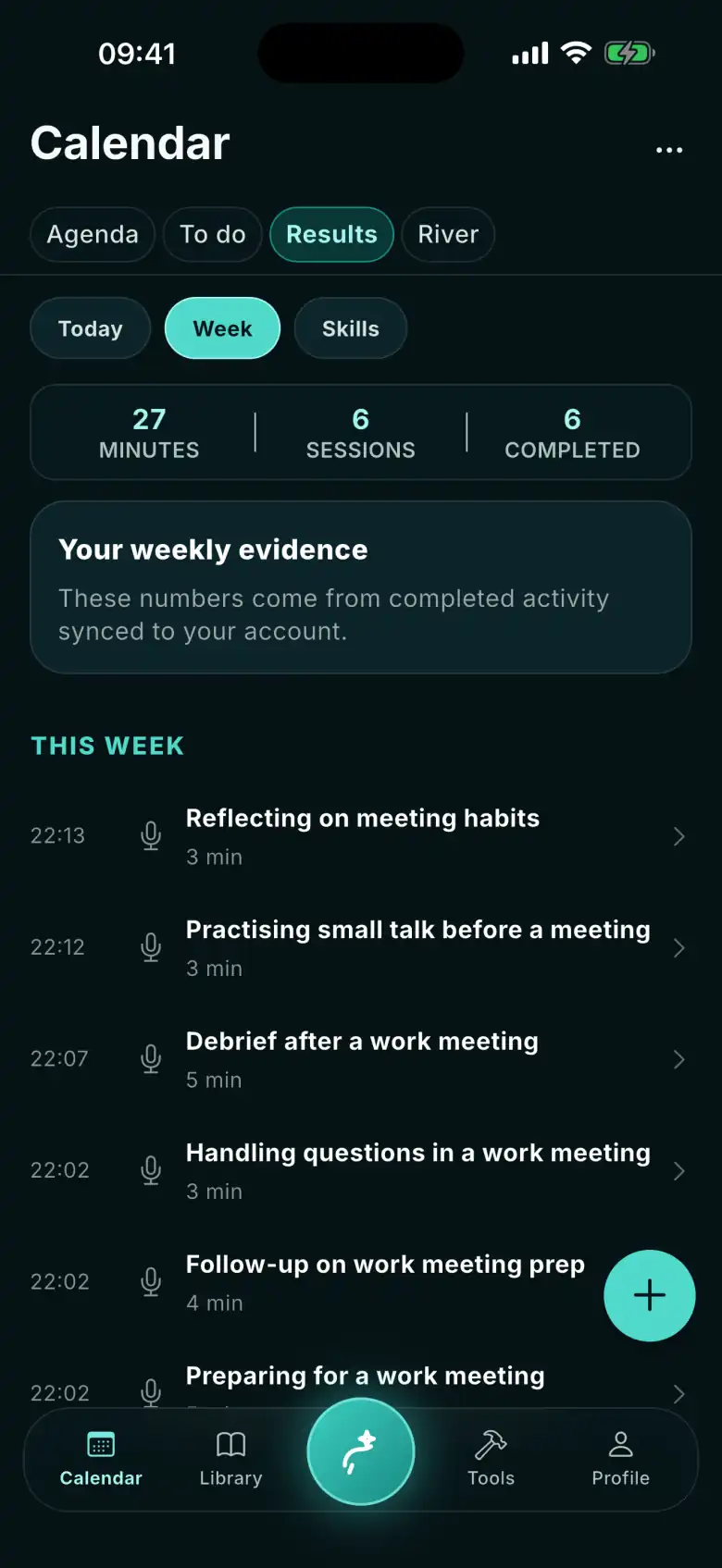
  • FizzUp calendar, Results → Week: 27 minutes, 6 sessions, 6 completed and a list of this week’s conversations
    The employee’s screen (demo account): their week — minutes, sessions and conversations. The company sees group totals only.

Situations at work

Same method, different conversation.

Five teams, and the conversations worth practising in each. These are example situations, not customer stories — we’ll publish those only with each company’s consent.

  • Sales teams

    Opening a discovery call

    Weaker:I want to know more about your needs.

    Better:Walk me through what you're trying to solve right now.

    Handling a price objection

    Weaker:Our price is like this because the quality is good.

    Better:Let's look at what's driving the number — and where the value lands for you.

    Asking for the close

    Weaker:So, what do you think about buying it?

    Better:What would need to be true for us to move forward this quarter?

  • Engineering teams

    Giving a standup update

    Weaker:Yesterday I did the API and today I will do the bug.

    Better:Yesterday I wrapped the API; today I'm chasing down the auth bug.

    Pushing back in a design review

    Weaker:Maybe this is not so good idea, I think.

    Better:I'd push back on that — it couples the services in a way we'll regret.

    On an incident call

    Weaker:The system is down and I don't know exactly why for now.

    Better:We're seeing a full outage; I'm narrowing it to the database layer now.

  • HR & People teams

    Opening an interview

    Weaker:Tell me about you and your experiences please.

    Better:Let's start with what drew you to this role — walk me through your path.

    Giving difficult feedback

    Weaker:Your work this quarter was not good enough for us.

    Better:I want to be honest about where this quarter fell short — and how we close the gap.

    A sensitive policy conversation

    Weaker:You must do this, it is the rule of company.

    Better:I know this is a lot to take in — here's the policy, and here's the support around it.

  • Finance teams

    Presenting quarterly results

    Weaker:The numbers are going down a little this quarter.

    Better:We're down 4% quarter-on-quarter, driven mainly by FX.

    Answering an audit question

    Weaker:I think maybe this number is like this because of the costs.

    Better:That variance reflects one-off restructuring costs — here's the breakdown.

    On an investor call

    Weaker:We hope the next quarter will be better than now.

    Better:We're guiding to a stronger Q3 on the back of the new contracts.

  • Customer support

    Opening a support call

    Weaker:Hello, what is your problem today?

    Better:Hi, thanks for calling — tell me what's going on and I'll help.

    Handling an upset customer

    Weaker:Please calm down, it is not my fault.

    Better:I hear you — that's frustrating. Let's get it sorted right now.

    Closing a resolved ticket

    Weaker:Your problem is solved. Bye.

    Better:All sorted on our side — anything else before you go?

Try it on a sentence from your team

Type a sentence someone on your team said in English this week. Malcolm shows you a better version — and explains why. No account needed.

Try it on your own sentence

Say it better.

Type a sentence you’d say in English at work. Malcolm shows you a better version — and why. No account needed, up to 10 sentences a day.

0/10 today0/240 (240)

Or start from one of these

Openly AI. No pretending to be human. Your sentence isn’t stored.

Getting started

How a team gets started.

None of this needs a project on your side before anyone speaks English out loud.

  1. 1

    An intro call

    20 minutes with me. I ask where English gets in your team’s way, and show you a live conversation with Malcolm on one of those situations.

  2. 2

    Scenarios

    2–3 scenarios drawn from situations your people actually face. We agree them together after the intro call.

  3. 3

    A launch session

    One session with the group: what this is, what stays private, how to start. Everyone picks their own AI coach.

  4. 4

    A decision after 6 weeks

    Carry on, change the scope, or stop. We decide together, based on the group’s combined results.

There are three ways to give access: invitations from a list (to work email addresses), access codes, or importing a list you’ve prepared. Removing access takes one click — when someone leaves the team, their access goes with them.

Price

We start with a pilot: 6 weeks, PLN 120 + VAT per participant per month.

We agree the scope and 2–3 scenarios after an intro call — and the price is on the table from day one. After the pilot we decide together: carry on, change the scope, or stop.

For teams

Founding Companies Programme

PLN 120 + VAT

per participant per month during the pilot

  • A 6-week pilot — PLN 180 + VAT per participant, start to finish
  • 15–30 people, with 2–3 scenarios we agree with you after a first call
  • 720 minutes of conversation per participant every 30 days
  • The company sees group results — never anyone’s conversations or mistakes
  • We take companies one at a time — only as many as we can run well

After the pilot

  • PLN 149 + VAT per active participant per month
  • 600 minutes of conversation per person per month
  • No annual contract, 30 days’ notice
Full terms and pricing questions  ›

The rules

What we commit to, in writing.

  • The company sees group results. Never a person’s words.
  • The employee decides what the AI coach keeps — and can delete it.
  • Data doesn’t train AI without explicit consent.
  • Taking part is voluntary — anyone can leave the programme and keep their own account.
See what we can prove  ›Enterprise terms and data processing agreement (DPA)  ›

Four AI coaches. Each suited to a different conversation at work.

The employee chooses, not the company. All four are openly AI and use the same method.

Malcolm — FizzUp AI coach

Malcolm

Everyday meetings and status updates: “Tell the client the project will slip — without it sounding like an excuse.”

Theo — FizzUp AI coach

Theo

High-stakes moments: a negotiation, a price objection, a board presentation.

Sophie — FizzUp AI coach

Sophie

For people who understand English but don’t speak it. The calmest place to start — which matters in a group where not everyone feels confident.

Emma — FizzUp AI coach

Emma

Register and tone: tough feedback, an email to head office, a conversation with HR.

Let’s talk about a pilot for your team.

20 minutes with me. First I ask where English gets in your team’s way. At the end, I tell you honestly whether I see a fit. — Piotr Wiśniewski, FizzUp founder